The Montessori Method
An educational method and philosophy that recognizes children's natural curiosity and desire to learn.
What is The Montessori Method?
The Montessori Method is an educational method and philosophy that recognizes children’s natural curiosity and desire to learn.
The name originates from Dr. Maria Montessori, Italy’s first female medical doctor. Born in 1870, Dr. Montessori studied the behavior and development and children to create a new environment for learning. Dr. Montessori perceived that the years between birth and six years are those with the greatest potential for learning. For this sensitive period in a child’s life, Dr. Montessori designed the “prepared environment where the child, set free from undue adult intervention, can live its life according to the laws of its development.”
In 1907, she founded the first Montessori school in Rome, Casa dei Bambini, or “Children’s House.” Since this time, her methods have been celebrated and continued in the world of early childhood education.
Today, certified Montessori directresses and special Montessori teaching materials incorporate this curiosity into a modern learning experience.
- Founded by
- Dr. Maria Montessori, born 1870
- First school
- Casa dei Bambini, Rome, 1907
- Greatest potential
- Birth to six years
The child, set free from undue adult intervention, can live its life according to the laws of its development.
Ages vs. Stages
Unlike some daycare centers that separate children by age, Montessori classrooms are separated by developmental stages. North American Montessori Child Care schools teach children from 6 weeks to 6 years, but whether a child belongs in an infant room, a transition room, a toddler room or a pre-school room is determined by what skills they have accomplished.
Every child develops at a different rate, so it is important to ensure they master certain skills in a safe, encouraging environment.
6 WEEKS – 18 MONTHS
Infant & Transition Rooms
The youngest, most dependent children are put into infant rooms. They are as young as 6 weeks old and up to about 8 months. Children who are crawling or rolling deserve lots of floor time and are separated from older walking/running children to avoid any collision accidents.
on their feet, around 15 months
15 MONTHS – 3 YEARS
Toddler Rooms
The older toddlers are considered those who have dropped their morning nap, are not using bottles, and are eating table foods.
ready for more, around 3
3 – 6 YEARS
Preschool
The full five-area Montessori curriculum in a mixed-age classroom, where older children teach younger ones and everyone moves at their own pace.
The Five Areas of Montessori Education
The Montessori Method’s prepared environment includes the following five areas:
Each area, in more depth
Each of these areas builds on logical and creative tasks and experiences to allow your child to grow in a well-rounded variety of ways. The Montessori directress, the Montessori equipment and the prepared environment all stimulate and encourage children to learn. Children learn by associating an abstract concept with a concrete sensorial experience rather than purely by memorization. By incorporating learning on every cognitive level, the Montessori method stimulates your child’s healthy early development.
Practical Life
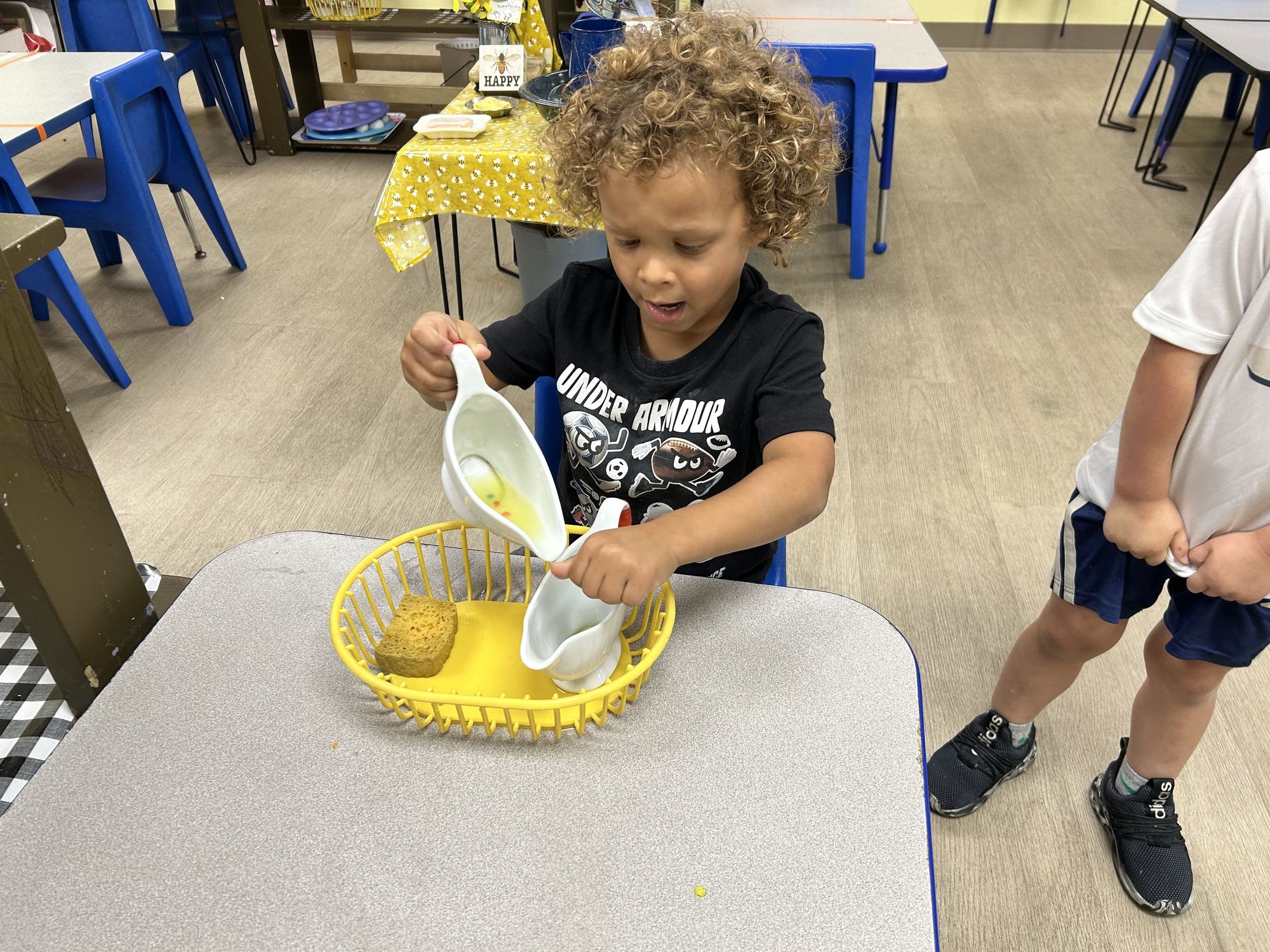
The exercises in Practical Life cover two main areas of development: care of self and care of the environment. These exercises in daily living provide the foundation for all other activities in the Montessori classroom. Specifically, these activities contribute to the control and coordination of movement, development of concentration, and the self-esteem that comes with making a real contribution to the group.
Sensorial
Sensorial experiences began at birth, and children, especially, are “sensorial explorers.” Montessori Sensorial exercises are focused on giving children the keys to study, understand, and classify the things around them. Sensorial exercises provide the first steps in organizing the child’s intelligence which leads to them being able to adapt to their environment.
Language
Language given to children within the context of their experiences is essential to Montessori education. Children need to know the names, labels, and the meanings of things in their environment for them to have relevancy. The transition to reading and writing is dependent on a strong vocabulary, and a child who is taught through varied experiences will develop a well-rounded vocabulary. Montessori Language exercises help children express thoughts and understand and interpret the thoughts of others.
Mathematics
All of the child’s work with Practical Life and Sensorial exercises brings order to their experiences and prepares them to further explore and mature their mathematical mind. Young minds are full of energy that propels them to absorb, manipulate, classify, order, sequence, abstract, and repeat. Montessori math exercises lead the child through progressive, hands-on activities and emphasize concepts while preparing the child for abstractions.
Culture
Montessori Culture exercises provide children with an opportunity to explore the larger world. Students learn about people, terrain, and animals through a rich exploration of the different cultures of the world. By celebrating other traditions with food, music, and stories, children can begin to see the uniqueness of other cultures, yet come to understand how much we all have in common.
Prepared Environments
Various cognitive, developmental, and life skills can be taught through direct hands-on experiences. The Montessori Method outlines that the best way to encourage learning is through prepared environments or a place where objects, floor plans and activities are designed specifically to inspire and support a child’s learning process. The prepared environment of the Montessori classroom is supplied with didactic (self-teaching) materials that can be manipulated by the children. The materials are designed to foster independence, develop a healthy self-concept, encourage thinking and give an appreciation of nature and the world.
Montessori Method of Teaching
While it may seem like just semantics, North American Montessori takes the role of directress seriously. Unlike the stereotypical teacher role, who stands in front of a class and dictates what they should be learning through a three-step process:
- Step 1
Show
The directress shows the child the skill they should learn.
- Step 2
Guide
The directress oversees the child as they attempt to perform the skill.
- Step 3
Master
The child practices and masters the skill on their own.
This process encourages the child’s unique joy for learning and improves their self-confidence.
Trust, earned one family at a time
I visited several schools before choosing Casa Dia Montessori. And I wouldn’t send my daughter anywhere else. Her teachers are amazing and the school’s Headmistress is competent, smart, and caring. I feel comfortable leaving my daughter in the staff’s care. And she is learning so much.
I have a 2 year old and a 4 year old going to Casa Dia Montessori and I couldn’t be happier. The facility is very clean, the food they serve is healthy, the teachers are top notch and my children love going to school there. No child care center’s rates are good, but they are extremely competitive for what their competition is. they are actually lower than any of their peers in the industry. Can’t say anything more than I wouldn’t go anywhere else.
Really enjoy the teaching and learning style at CAC. My 2 year old has excelled with her ABCs, drawing, singing and cleaning up. Social interaction is great and she obviously has confidence from what she learns.
Is Montessori Daycare Center For You? Schedule A Tour
Call one of North American Montessori's child care centers today to schedule a tour, enroll a child in our schools, or simply to learn more about the benefits of choosing a child care center as the new caregiver for your child.